

Immediate termination clauses allow a physician assistant employer or contracting entity to end the professional relationship without the notice period ordinarily associated with without-cause termination. Depending on the agreement, this action may immediately stop compensation and benefits, affect facility credentials, and trigger provisions governing bonus repayment, malpractice coverage, restrictive covenants, or final productivity pay. The consequences can therefore extend well beyond the loss of a position.
The language matters because many PA employment and independent contractor agreements give the employer broad discretion to decide what constitutes cause. Objective events such as loss of licensure may be listed alongside subjective standards such as conduct detrimental to the employer or loss of confidence. An agreement may also omit a notice-and-cure period, allowing an alleged breach to produce immediate financial and professional consequences without an opportunity to correct the issue.
Chelle Law reviews how immediate termination interacts with compensation, repayment obligations, malpractice insurance, credentialing, and post-employment restrictions. A careful PA termination clause review can identify these risks before signing, while prompt legal review after an adverse action can help a PA understand deadlines, preserve relevant records, and evaluate the employer’s asserted grounds.
How Immediate Termination Works in a PA Contract
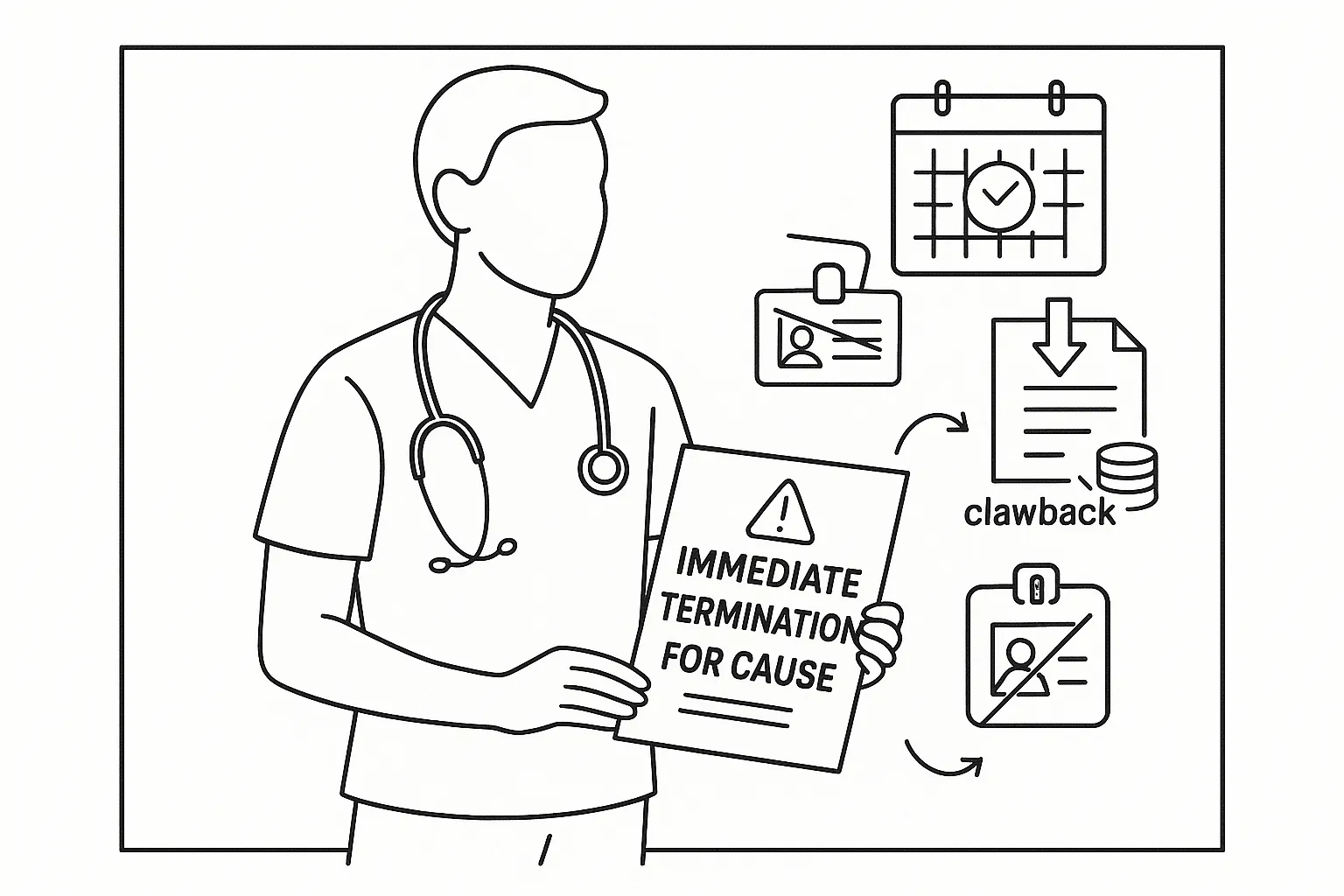
Immediate termination, sometimes described as termination for cause without notice, permits the employer to end the relationship immediately when a specified event occurs. The practical effect may include an interruption of pay, suspension or loss of facility credentials, termination of benefits, and repayment demands involving a signing bonus, relocation assistance, loan support, or an upfront CME stipend.
This mechanism differs from without-cause termination, which may provide advance notice and allow the PA to continue working and receiving compensation during the notice period. Immediate termination can bypass those protections. It may also establish the date used to calculate final compensation, benefit termination, malpractice obligations, and the start of post-employment restrictions.
For-Cause Triggers and Employer Discretion
Objective Events That May Permit Immediate Termination
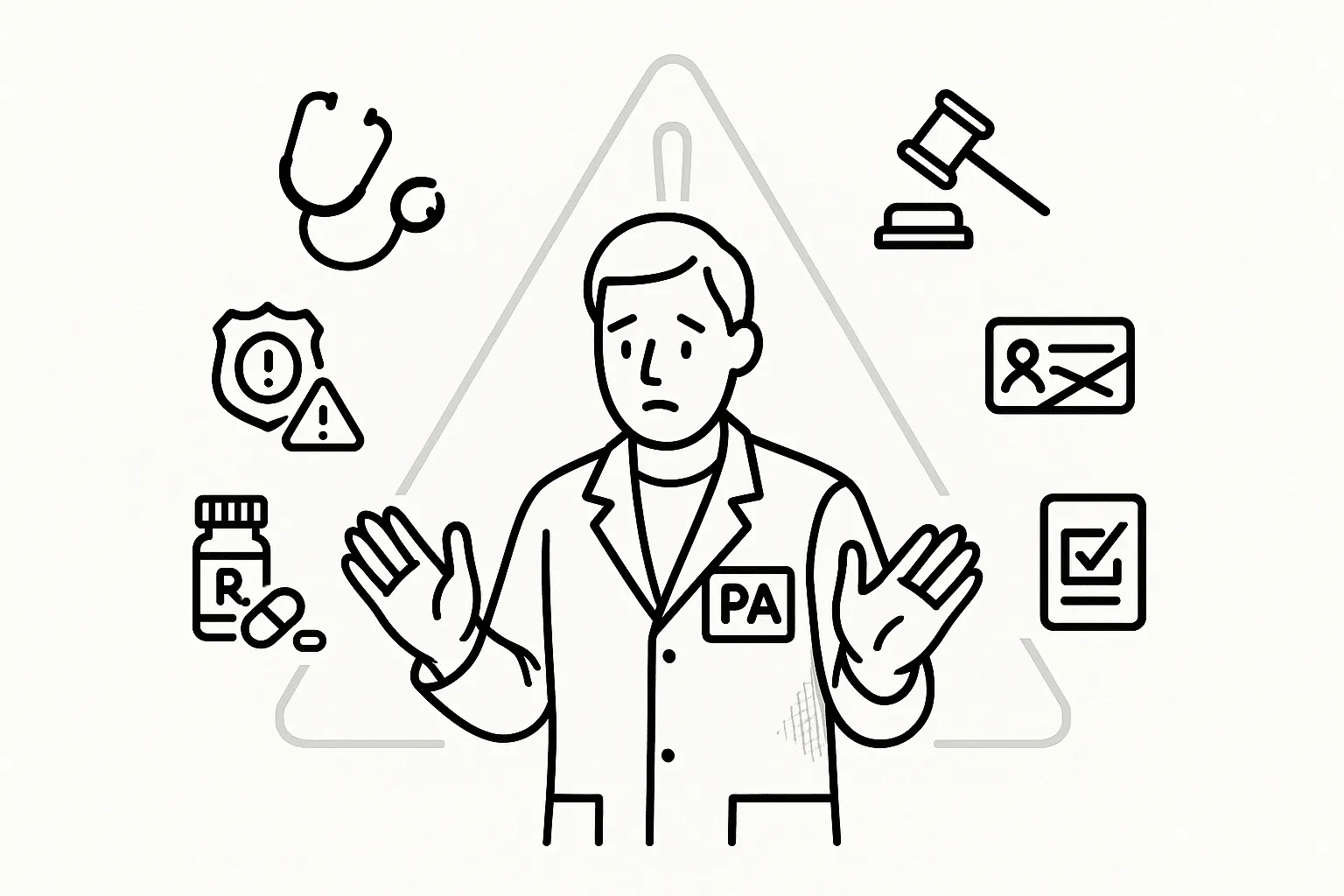
PA agreements commonly identify specific events that permit termination for cause. Although the language differs by contract, listed grounds may include:
- Gross negligence, fraud, patient abandonment, or other serious professional misconduct.
- A felony conviction or specified criminal conduct involving dishonesty or harm.
- Suspension, revocation, or failure to maintain a required license, certification, registration, or credential.
- Controlled-substance diversion or serious prescribing or DEA-related irregularities.
- A material contract breach or intentional or repeated violation of applicable employer policies.
- Failure to comply with applicable supervision, collaboration, delegation, or scope-of-practice requirements.
The agreement should be read closely to determine whether the occurrence of an event automatically establishes cause or whether the employer must investigate, provide written notice, or make a documented finding. Definitions tied to licensure, credentialing, and professional conduct should also be compared with the PA’s actual responsibilities and applicable practice requirements.
Subjective Standards, Notice, and an Opportunity to Cure
Broader phrases such as “conduct detrimental to the employer,” “failure to meet expectations,” or “loss of confidence” can substantially expand employer discretion. These standards may be difficult to measure or contest, particularly when the contract does not require the employer to identify the underlying conduct with specificity.
A notice-and-cure provision may require written notice and give the PA time to correct certain breaches before termination becomes effective. Not every alleged violation is reasonably curable, but the contract should distinguish serious events that justify immediate action from administrative, documentation, or policy issues that could be addressed. The PA should also determine whether internal review, credentialing, or appeal procedures impose separate deadlines.
Financial and Professional Consequences
Final Pay, Productivity Compensation, and Repayment Demands
Immediate termination can interrupt base salary and leave variable compensation unresolved. An RVU, collections, draw, or bonus formula may delay reconciliation until after departure, exclude work not billed or collected by a deadline, or create a deficit the employer attempts to recover. A detailed review of PA compensation and productivity terms can clarify when compensation is earned, when it is paid, and whether it can be forfeited following termination.
Repayment provisions may apply to signing bonuses, relocation funds, educational assistance, or other advances. The amount may be prorated based on completed service or become immediately due in full. Because the trigger can differ depending on whether the PA resigns, is terminated without cause, or is terminated for cause, the sign-on bonus repayment language should be reviewed together with the termination section rather than in isolation.
- Confirm how earned wages, accrued paid time off, bonuses, and productivity compensation are treated.
- Identify any negative accrual, draw reconciliation, chargeback, or post-termination collection adjustment.
- Determine whether repayment is prorated and which termination events activate it.
- Review whether the employer may deduct an asserted debt from the final payment.
Malpractice Coverage, Credentialing, and Practice Restrictions
Employer-provided malpractice coverage may end with employment. If the policy is claims-made, the agreement should identify who is responsible for extended reporting coverage after termination and whether responsibility changes when termination is for cause. The distinction between occurrence coverage and a claims-made policy requiring tail insurance for a physician assistant can create a significant post-employment expense.
An immediate termination may also affect facility privileges, payer enrollment, references, and future credentialing. Depending on the underlying event and applicable requirements, separate reporting or response obligations may arise. PAs should not assume that an employment decision automatically establishes professional misconduct, but they should promptly identify any credentialing, licensing, or administrative process connected to the termination.
Post-employment non-compete and non-solicitation provisions may further limit mobility. The agreement should establish whether restrictions apply after every separation or only after specified events, as well as how their duration and geographic scope are calculated. A focused physician assistant non-compete review can evaluate these provisions alongside the termination language that activates them.
Contract Terms to Review Before Signing
Pre-signing review should examine immediate termination as part of the agreement’s larger risk structure. A favorable notice provision offers limited protection if an expansive for-cause clause allows the employer to bypass it, while attractive compensation may be less valuable if the employer can forfeit unpaid bonuses or demand repayment after an immediate termination.
- Definition of cause: Determine whether each ground is objective, material, and connected to the PA’s actual duties.
- Notice and cure rights: Identify which alleged breaches require written notice and a reasonable opportunity to correct the issue.
- Compensation treatment: Verify how salary, PTO, bonuses, RVU compensation, collections, and draws are calculated at termination.
- Benefits and insurance: Establish when health benefits and malpractice coverage end and who is responsible for tail coverage.
- Repayment obligations: Locate every provision governing bonus, relocation, loan, stipend, or training-cost repayment.
- Post-employment restrictions: Determine whether termination for cause changes a non-compete, non-solicitation clause, or other restrictive covenant.
These terms should be reviewed together rather than clause by clause in isolation. A comprehensive physician assistant contract review can show how a termination event affects compensation, insurance, repayment, and future employment at the same time.
Steps to Take After an Immediate Termination
If an employer executes immediate termination, the first priorities are preserving documents, identifying deadlines, and obtaining a clear written record. Avoid altering or removing employer-owned records, but retain lawful copies of the agreement and personal employment documents already available to you.
- Preserve the contract, amendments, compensation reports, pay statements, bonus communications, supervision agreements, and referenced policies.
- Request the termination notice and the employer’s asserted grounds in writing.
- Confirm the final dates of health benefits, malpractice coverage, credentialing access, and other employer-provided benefits.
- Document relevant dates, conversations, witnesses, complaints, and hospital or administrative actions.
- Avoid speculative statements or informal admissions before understanding the contractual and licensing implications.
- Review any notice, appeal, repayment, or response deadline immediately.
These measures help counsel assess whether the employer followed the contract, whether a repayment demand is supported, and whether licensing, credentialing, or malpractice issues require a separate response. Additional guidance on terminating a PA contract can help distinguish immediate for-cause termination from other separation procedures.
When to Seek Legal Review or Representation
Legal review is useful before signing and immediately after an adverse employment action. Before signing, an attorney can identify broad cause definitions, missing cure rights, compensation forfeiture, repayment exposure, malpractice obligations, and restrictions that may limit the PA’s next position. This allows the PA to evaluate the offer with a clearer understanding of the downside risk.
After termination, prompt review becomes especially important when the employer alleges professional misconduct, threatens a licensing or credentialing report, demands substantial repayment, withholds earned compensation, or seeks to enforce a restrictive covenant. Counsel can review the agreement and supporting documents, identify relevant contractual procedures, and explain potential claims, defenses, or administrative response options without relying on the employer’s characterization of events.
Frequently Asked Questions
Can a PA employer terminate a contract immediately without notice?
An employer may rely on an immediate termination provision when the agreement permits termination for cause without advance notice and the asserted event falls within the clause. Whether the employer properly applied that provision depends on the contract language, the facts, and any required notice, investigation, cure, or review procedure.
Does immediate termination automatically eliminate a PA’s final bonus?
Not necessarily. The result depends on when the bonus is considered earned, whether payment requires continued employment on a specified date, and whether the contract permits forfeiture after termination. Productivity and collections-based compensation may also require a post-termination reconciliation.
Can termination for cause trigger repayment of a signing bonus?
Yes, if the repayment provision identifies termination for cause as a triggering event. The contract should be reviewed to determine whether repayment is full or prorated, when it becomes due, and whether different rules apply to resignation, without-cause termination, and for-cause termination.
Who pays for malpractice tail coverage after immediate termination?
The agreement and insurance arrangement control responsibility. If the employer provides claims-made coverage, the contract may assign tail coverage to the employer or the PA and may change that allocation based on how the relationship ends. Occurrence policies generally do not require tail coverage for prior covered acts.
Does immediate termination make a PA non-compete enforceable?
Termination may activate a contractual non-compete, but the effect and enforceability of the restriction depend on the agreement and applicable law. The clause should be reviewed for its trigger, duration, geographic reach, restricted activities, and any exception based on the reason for termination.
What documents should a PA preserve after being terminated?
A PA should preserve lawful copies of the contract and amendments, termination notice, compensation records, pay statements, relevant communications, supervision documents, referenced policies, benefit information, and a timeline of events. Patient records and employer-owned confidential materials should not be removed without authorization.
Review Immediate Termination Risks Before They Escalate
Chelle Law reviews physician assistant agreements and termination provisions to identify compensation, repayment, malpractice, credentialing, and restrictive covenant exposure.
Contact Chelle LawExplore Physician Assistant Contract Guidance
Review legal services, practical contract resources, and state-specific information for physician assistants.