

Quality-based bonuses are increasingly common in physician assistant (PA) employment agreements and independent contractor arrangements. These incentives can materially increase total compensation, but their value depends on more than the stated bonus amount. Eligibility conditions, performance measures, data sources, payment timing, and reconciliation provisions determine whether a PA can realistically earn and retain the promised compensation.
Problems arise when the employer controls the underlying data, may revise metrics after the measurement period, or conditions payment on productivity thresholds and continued employment. Negative accrual, repayment, and clawback language can turn an incentive into a financial liability. Operational issues such as staffing shortages, EHR configuration, payer changes, supervision, and multi-site assignments may also affect performance even when the PA has limited control over those conditions.
A careful review should connect the quality formula to the agreement’s broader compensation and termination provisions. Chelle Law evaluates bonus calculations, audit rights, repayment exposure, employment-status requirements, and employer-controlled dependencies so PAs can understand the likely financial consequences before signing. This review is a risk-management and income-protection decision, not merely a procedural formality.
How PA Quality Bonuses Are Structured
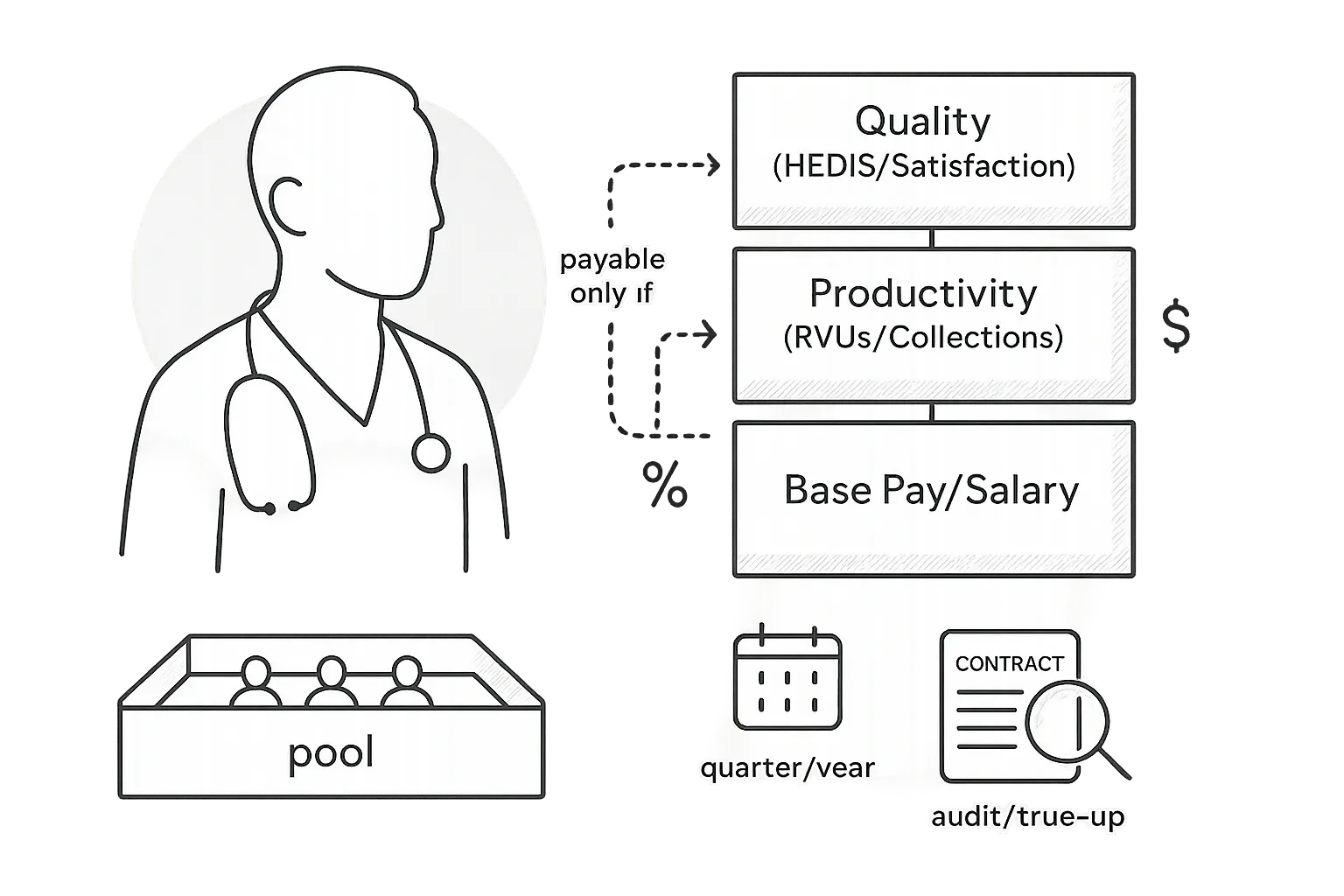
Quality bonuses are generally layered on top of a base salary, collections model, productivity formula, or RVU-based compensation plan. Common structures include threshold bonuses tied to defined performance measures, percentage-of-pay incentives, fixed-dollar payments, and shared-savings arrangements in which a practice distributes part of the financial gain from a quality program.
- Fixed target: A stated payment if all identified quality measures are met.
- Pro rata payout: A percentage of salary or a maximum bonus based on the proportion of targets achieved.
- Pool distribution: A shared bonus pool allocated among clinicians using RVUs, collections, quality scores, or another formula.
Many agreements make quality compensation contingent on first satisfying a productivity or revenue threshold. A PA may meet the quality measures but receive only part of the incentive—or nothing—because the agreement requires a separate collections or RVU target. Reviewing the complete compensation and productivity formula is therefore essential when estimating the bonus’s actual value.
Payment may occur quarterly or annually and may be subject to a later true-up. Some agreements permit withholding while the employer reviews billing adjustments, chargebacks, or audit findings. These provisions require careful attention because an announced or previously paid bonus may remain exposed to later reduction or repayment.
Contract Terms That Create Quality Bonus Risk

Quality bonus provisions should be read together with the agreement’s compensation, termination, policy-incorporation, and repayment sections. Language that appears routine can give the employer broad discretion while shifting economic risk to the PA.
Negative Accrual, Draws, and Clawbacks
A guaranteed base salary may be paired with a reconciliation provision that treats future quality compensation as an offset against a negative balance. Draw provisions can create similar exposure when an employer advances anticipated compensation and later requires repayment because production or quality benchmarks were not achieved. PAs should understand how negative accrual provisions interact with the quality formula, base salary, and final compensation.
Clawbacks may also arise after termination, audit adjustments, billing corrections, or a later employer determination that an overpayment occurred. Risk increases when repayment is mandatory but the contract provides no limit on the amount, timing, calculation method, or employer accounting standard. A unilateral right to identify inaccurate data or overpayments can leave the PA responsible for adjustments outside the PA’s control.
Eligibility, Employment Status, and Employer Discretion
Some contracts require the PA to be actively employed on the payment date rather than merely employed during the measurement period. That distinction can cause forfeiture after a resignation, involuntary termination, reduction in hours, or reclassification even when the PA substantially completed the work used to generate the bonus. The quality provision should therefore be reviewed alongside the agreement’s termination and final-pay terms.
Other agreements condition payment on compliance with employer policies that are not attached to the contract or permit the employer to modify metrics in its sole discretion. Broad audit and adjustment rights are especially concerning when there are no notice requirements, review procedures, correction opportunities, or deadlines for recalculation.
Measurement Methods and Data Transparency
Quality bonuses depend on accurate, auditable information. The agreement should identify the metric source, calculation methodology, measurement period, and responsible party. Claims data, EHR reports, payer quality systems, and aggregate practice reports may produce different results, particularly when denominator exclusions, attribution rules, or look-back periods are not clearly defined.
Metric Definitions, RVUs, and Access to Reports
The contract should explain whether scores are calculated monthly, quarterly, or annually and whether results are averaged or measured at a single point. It should also address the PA’s access to underlying reports and the process for correcting attribution, coding, or documentation errors. Without meaningful access to the data, it may be difficult to verify the calculation or contest an incorrect reduction.
Consider a quality pool distributed according to each clinician’s RVUs. If the employer uses billed units rather than adjusted or payer-allowed units, clinicians working with different payer mixes may receive materially different shares. The agreement should identify the applicable RVU definition, treatment of denials, modifiers, and shared procedures. PAs unfamiliar with these calculations may also benefit from reviewing how RVU compensation works.
Data lag creates additional risk. Retrospective billing changes may reduce reported productivity after a bonus has been announced or paid. Contract language should establish a defined reconciliation window, explain when calculations become final, and identify any limits on recovery rather than allowing indefinite recalculation.
Operational and Clinical Factors That Affect Payment
Bonus attainment may depend on conditions controlled partly or entirely by the employer. Staffing shortages and patient-access limitations can reduce throughput, while EHR configuration and documentation workflows can determine whether completed care is captured by a quality measure. Changes in payer mix, payer policy, clinical guidelines, or measure specifications may also alter the calculation during the contract term.
- Staffing shortages or scheduling limitations that reduce patient access while targets remain unchanged.
- EHR workflows that fail to capture preventive care, follow-up, or other qualifying services.
- Payer or guideline changes that modify revenue, attribution rules, or quality-measure denominators.
- Facility-level performance measures that do not fairly allocate responsibility among clinicians.
Scope, Supervision, and Multi-Site Assignments
A quality target may assume that the PA can perform particular services, manage a defined patient panel, or work with consistent clinical support. State practice requirements, supervision or collaboration arrangements, delegation limits, and employer scheduling decisions may affect whether those assumptions are realistic. Agreements should identify employer responsibilities when the bonus depends on necessary coverage, delegation, staffing, or clinical authority.
Multi-site assignments can create similar problems when compensation depends on facility-level performance. A PA moved among locations may have little control over local staffing, patient populations, or documentation systems. The agreement should explain how credit is assigned and whether targets adjust when the employer changes the PA’s location, schedule, duties, or scope.
Financial Protections to Review Before Signing
A quality bonus provision should make the economic outcome reasonably understandable before the PA begins work. Important terms include exact metrics, data sources, measurement periods, calculation formulas, payout dates, and the conditions under which a result may be revised. When the incentive incorporates productivity, the agreement should define the relevant collections or RVU methodology rather than relying on an unpublished employer formula.
- Defined audit procedures: A clear review window, written notice of findings, access to supporting reports, and an opportunity to correct errors.
- Repayment safeguards: Limits on clawbacks, a defined reconciliation schedule, and protection from repayment caused solely by employer systems or accounting errors.
- Payment timing: A specific payout deadline and an explanation of when the calculation becomes final.
- Pro rata treatment: Clear handling of earned but unpaid compensation when employment ends during or after a measurement period.
- Operational responsibility: Identification of the staffing, supervision, delegation, data access, and system support the employer must provide.
These terms should be considered with the agreement’s broader repayment and post-employment obligations. Bonus forfeiture can compound other financial consequences, including sign-on bonus repayment, tail insurance costs, or delayed final compensation. Understanding malpractice insurance responsibilities and other exit-related expenses provides a more complete view of the risk.
When an Attorney Should Review the Bonus Terms
Legal review is particularly important when a quality incentive represents a meaningful portion of expected compensation, the methodology is unclear, or the employer retains broad authority to adjust data and determine eligibility. Review is also warranted when the agreement contains negative accrual, draw repayment, clawback language, an active-employment condition, or references to policies that are not attached.
Chelle Law examines base compensation, productivity and collections formulas, quality metrics, reconciliation provisions, audit rights, repayment exposure, and termination triggers that affect payment. The review also considers supervision and delegation terms, employer-controlled operational factors, and other provisions that may shift financial or professional risk to the PA. A comprehensive physician assistant contract review helps clarify how the bonus works within the entire employment relationship rather than treating it as an isolated incentive.
Boilerplate language can appear neutral while giving the employer significant control over whether compensation is earned, calculated, or retained. An attorney can identify those provisions, explain their practical effect on income and mobility, and help the PA understand which terms require clarification before signing.
Frequently Asked Questions
Can a PA earn a quality bonus but still lose it before payment?
Yes. An agreement may require the PA to remain actively employed on the payment date or satisfy a separate productivity threshold. A PA who met the quality measures could still forfeit the payment after resignation, termination, a reduction in hours, or failure to satisfy another contractual condition.
What information should a PA quality bonus formula identify?
The formula should identify the metrics, data sources, measurement period, calculation method, payout timing, eligibility conditions, and reconciliation process. If RVUs or collections affect payment, the agreement should also define how those figures are calculated and adjusted.
Why do employer audit rights matter for a quality bonus?
Broad audit rights may allow the employer to revise performance data or characterize compensation as an overpayment after a bonus is announced or paid. Clear deadlines, written notice, supporting documentation, and a correction or dispute process reduce the risk of open-ended adjustments.
Can staffing or EHR problems affect a PA’s bonus?
Yes. Staffing shortages, scheduling limitations, patient-access problems, and EHR workflows can affect both performance and whether qualifying care is captured. The contract should address employer-controlled conditions when they materially influence the PA’s ability to meet the stated metrics.
How can termination affect an unpaid quality bonus?
The result depends on the agreement’s eligibility and payment language. Some contracts provide pro rata treatment or payment for completed measurement periods, while others require active employment on the payout date or permit forfeiture when employment ends.
When should a PA seek legal review of a quality bonus?
Review is especially important when the bonus is a significant part of expected pay, the calculation is unclear, or the agreement includes clawbacks, negative accrual, unilateral adjustments, active-employment requirements, or employer policies that are not provided with the contract.
Understand Your PA Quality Bonus Before You Sign
Chelle Law reviews quality metrics, payout conditions, audit rights, clawbacks, and termination provisions so you can evaluate the real financial value of your agreement.
Contact Chelle LawExplore Physician Assistant Contract Guidance
Review legal services, practical contract resources, and state-specific guidance for physician assistants.