

A physician assistant offer letter usually summarizes the proposed position, compensation, start date, and benefits, while an attached employment agreement contains the detailed legal obligations that govern the relationship. Although the offer may look straightforward, its terms can affect a PA’s income, clinical responsibilities, malpractice exposure, and ability to leave for another opportunity. The documents should be read together rather than treating the offer letter as a complete statement of the deal.
Common mistakes include accepting an unclear productivity formula, overlooking whether compensation is guaranteed or recoverable, and failing to confirm call, scheduling, or multi-site obligations. Other risks arise when the documents do not clearly address worker classification, supervision, restrictive covenants, malpractice tail coverage, termination rights, or repayment of a signing bonus and relocation assistance. These provisions can create financial and professional consequences long after the offer is accepted.
Chelle Law compares the offer letter with the complete agreement, identifies inconsistencies, and explains how the language may operate in practice. An attorney-led physician assistant offer letter review can clarify the proposed compensation, benefits, duties, liability allocation, and exit terms before the PA commits to the position.
Compensation and Payment Terms That Require Clarification
Guaranteed Salary, Productivity Pay, and Bonus Formulas
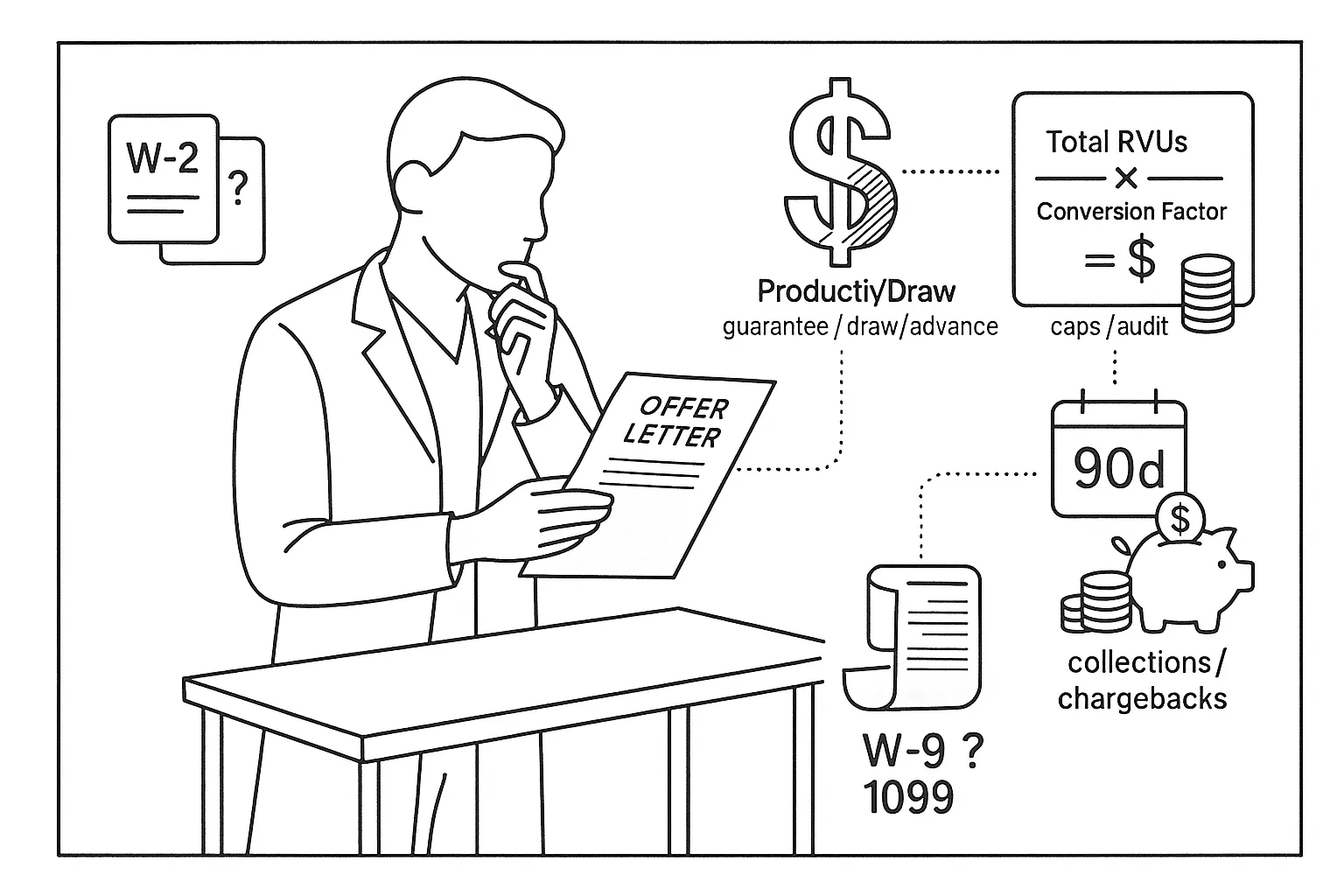
An offer letter may present one compensation figure without stating whether it is a guaranteed base salary, a temporary guarantee, a draw against future production, or an advance that can be recovered. A guaranteed W-2 salary generally provides more predictable cash flow, while a draw or advance may create negative accrual or repayment exposure. The documents should consistently define terms such as “base salary,” “guarantee,” “draw,” and “advance” and explain whether the compensation model changes after an initial period.
Productivity and bonus language also requires enough detail to verify earnings. An RVU formula should identify which RVUs are credited to the PA, the applicable threshold and conversion factor, the measurement period, and any quality adjustments, caps, reconciliation rights, or repayment provisions. A focused compensation and productivity review can reveal whether the formula is measurable and whether the employer can retroactively reduce or recover an incentive.
Collections, Deductions, and Payment Timing
Collections-based compensation creates additional timing and attribution concerns. The agreement should explain when collections are counted, which services and billing codes are attributed to the PA, how denials or patient nonpayment are handled, and whether the PA receives compensation for collections received after employment ends. Without those details, payment can be delayed for months or reduced through chargebacks that the PA cannot independently verify.
The documents should also disclose payroll timing and potential deductions for benefits, malpractice premiums, equipment, overpayments, or other expenses. Reconciliation and audit language deserves careful attention when it allows the employer to offset future wages or incentive payments. These terms should be evaluated alongside the complete compensation package rather than relying only on the headline salary in the offer letter.
Employment Classification, Clinical Duties, and Scheduling

W-2 Employment Versus 1099 Contractor Status
The offer letter and agreement should consistently state whether the PA will be a W-2 employee or a 1099 independent contractor. Classification affects tax withholding, benefits, retirement contributions, paid leave, unemployment protections, business expenses, and malpractice responsibilities. An independent contractor arrangement may shift substantial administrative costs and liability to the PA, so the stated rate should not be compared directly with a W-2 salary without accounting for those differences.
The contractual label should also be considered with the employer’s actual control over schedules, clinical protocols, meetings, systems, billing, and work locations. PAs evaluating a contractor offer can review the broader differences between W-2 and 1099 arrangements and determine whether the agreement clearly allocates taxes, benefits, insurance, and operating expenses.
Scope of Practice, Supervision, Call, and Work Locations
Broad language such as “perform other duties as assigned” can permit significant changes to the role without corresponding changes in compensation. The agreement should describe the expected specialty, procedures, patient population, work sites, administrative duties, and productivity standards with enough specificity to identify material expansions. Clinical obligations must also remain consistent with the PA’s training, credentialing, licensure, and applicable state supervision, collaboration, delegation, and prescribing requirements.
Supervision provisions should identify who is responsible for required agreements and how a change in the supervising or collaborating physician affects the PA’s ability to work. The documents should not promise unrestricted clinical autonomy if applicable law, credentialing standards, or facility policies impose additional requirements. Ambiguous allocation of these responsibilities can expose the PA to licensing, credentialing, and employment problems.
Call, weekend coverage, overtime, telehealth, and multi-site assignments should be addressed before the offer is accepted. Phrases such as “on call as needed” provide little protection against expanded coverage without additional pay. The agreement should explain frequency, response expectations, premium compensation, scheduling authority, travel, and whether the work generates productivity credit; a detailed guide to PA call and coverage requirements identifies the related questions to raise.
Malpractice Insurance, Tail Coverage, and Indemnification
A promise to provide malpractice insurance is incomplete unless the documents identify the policy type, coverage limits, exclusions, and the party responsible for post-employment protection. Occurrence coverage generally applies to incidents that occur during the policy period regardless of when the claim is later filed. Claims-made coverage ordinarily requires tail or other continuing protection when the policy ends so that later-filed claims arising from prior services remain covered.
The agreement should state who pays for tail coverage and whether that responsibility changes according to how employment ends. Some employers assume the expense only after a termination without cause or after the PA completes a specified service period. Because an unexpected tail obligation can materially affect the cost of leaving, PAs should understand the policy structure and tail insurance responsibility before signing.
Indemnification language may create exposure beyond the insurance policy by requiring the PA to reimburse the employer, fund defense expenses, or accept liability for broadly defined losses. Related provisions may control the selection of counsel, settlement authority, and responsibility for administrative or licensing matters. These clauses should be reconciled with the actual insurance coverage so the PA is not assuming obligations that the policy will not pay.
Non-Competes and Other Post-Employment Restrictions
Restrictive covenants can affect future mobility more than the initial compensation package. A non-compete may define a restricted period, geographic area, specialty, or group of facilities where the PA cannot work after employment. Multi-site provisions deserve particular attention because a radius measured from every employer location can cover a much larger area than the PA expects.
Non-solicitation provisions may restrict communications with patients, referral sources, or employees, while confidentiality and proprietary-information clauses can affect the use of professional contacts and work materials. Ambiguous definitions of “patient,” “solicit,” or “competitive activity” can create disputes over ordinary networking or a move to another practice. Enforceability varies with applicable law and the particular facts, but the practical career impact should be assessed before acceptance.
A review of the agreement’s non-compete and restrictive covenant terms can identify whether the duration, location, covered services, and termination triggers are clear. Negotiation priorities may include narrowing the restricted territory, excluding facilities where the PA never worked, limiting the covered specialty, or removing the restriction after specified employer-initiated termination events.
Termination, Repayment, and Dispute Terms
Termination provisions determine how quickly income can end and whether the PA has time to transition to another position. The agreement should distinguish termination for cause from termination without cause, define the notice required from each party, and explain whether the employer can remove the PA from the schedule during the notice period. Vague immediate-termination standards, such as failure to meet undefined employer expectations, can give the employer broad discretion without a meaningful opportunity to cure the issue.
Signing bonuses, relocation payments, education assistance, and other incentives frequently carry repayment obligations. The PA should determine which termination events trigger repayment, whether the amount is forgiven over time, and whether the employer can deduct the balance from final compensation. A seemingly valuable incentive can become a substantial liability if the agreement requires full repayment after most of the service period has been completed.
Probationary periods, performance standards, arbitration, governing law, venue, and fee-shifting provisions also affect the PA’s practical rights. Objective metrics and reasonable cure procedures can reduce the risk of abrupt termination based on subjective standards. Before signing, the PA should understand the complete termination and repayment framework, including compensation during notice, post-employment collections, bonus treatment, insurance obligations, and any restrictive covenant activated by departure.
Frequently Asked Questions
Is a physician assistant offer letter legally binding?
The legal effect depends on the wording, the surrounding documents, and applicable law. Some offer letters are expressly nonbinding except for selected provisions, while others contain definite obligations or incorporate an employment agreement. A PA should review both documents before accepting or signing.
What compensation details should be confirmed before accepting an offer?
Confirm whether compensation is guaranteed salary, a draw, collections-based pay, or productivity compensation. The documents should define thresholds, conversion factors, bonus timing, attribution rules, reconciliation rights, deductions, and any circumstances allowing the employer to recover previously paid compensation.
Why does W-2 or 1099 classification matter in a PA offer?
Classification affects tax withholding, benefits, paid leave, retirement contributions, business expenses, insurance obligations, and employment protections. A higher contractor rate may not offset expenses and liabilities that would otherwise be paid or administered by a W-2 employer.
Should an offer letter specify who pays for malpractice tail coverage?
Yes. If the position uses claims-made malpractice insurance, the documents should identify who obtains and pays for tail or other continuing coverage after employment ends. Responsibility may vary depending on the reason for termination or the length of service.
What should a PA examine in a non-compete clause?
Review the restricted duration, geographic area, covered services, facilities used to measure the restriction, and the termination events that activate it. The PA should also examine related non-solicitation, confidentiality, and enforcement provisions.
When can a signing bonus or relocation payment become repayable?
Repayment is generally controlled by the written offer and agreement. The documents should state which termination events trigger repayment, whether the obligation decreases over time, when payment is due, and whether the employer may deduct the amount from final compensation.
Review Your PA Offer Before You Sign
Chelle Law can explain the compensation, duties, malpractice obligations, restrictions, repayment terms, and termination provisions in your offer letter and employment agreement.
Contact Chelle LawExplore Physician Assistant Contract Guidance
Review legal services, practical contract resources, and state-specific guidance for physician assistants.